
How Many Brake Pads Does a Car Have and What Do They Cost to Replace?
How Many Brake Pads Does a Car Have and What Do They Cost to Replace?
If you’ve ever been told your brake pads need replacing, you may have wondered exactly how many brake pads your vehicle has and why the estimate varies from one vehicle to another. It’s one of the most common questions drivers ask during a brake inspection, especially when they are trying to understand what they’re paying for.
The answer is relatively simple, but there are several factors that affect brake service costs. Understanding how your brake system works can help you make informed decisions, avoid unnecessary repairs, and keep your vehicle safe on the road.
At Schlenker Automotive, we believe educated customers make better maintenance decisions for brakes and tires in Rockledge, FL. Here’s what every driver should know about brake pads, brake systems, and replacement costs.
How Many Brake Pads Does a Car Have?
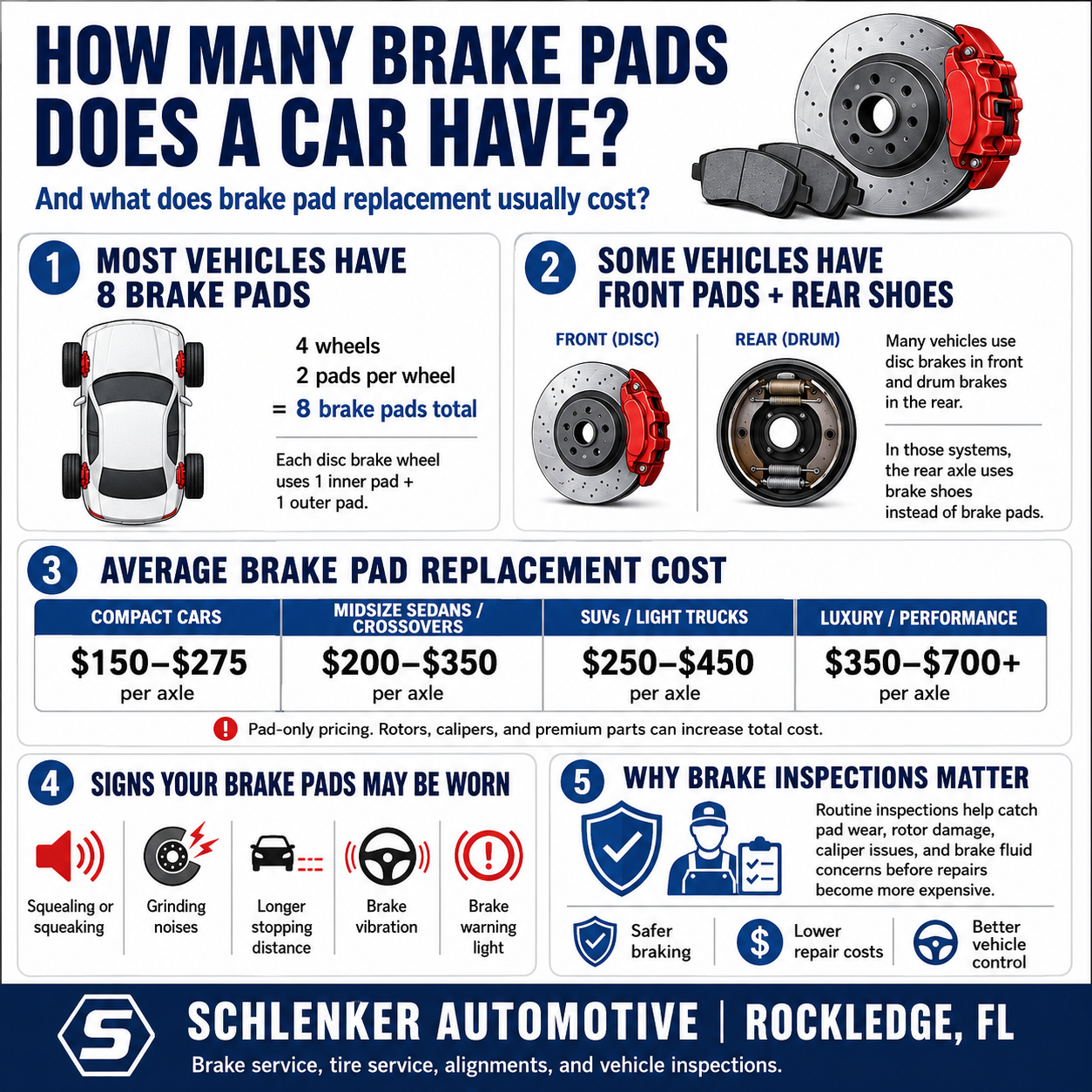
Most modern vehicles equipped with four-wheel disc brakes have a total of eight brake pads.
Each wheel contains a brake caliper that holds two brake pads:
- One inner brake pad
- One outer brake pad
Since there are four wheels, that equals eight brake pads in total. When you press the brake pedal, hydraulic pressure forces the brake pads against the brake rotor. The resulting friction slows the rotation of the wheels and brings the vehicle to a stop.
Because brake pads wear down over time, they are considered a routine maintenance item and require periodic replacement.
Do All Vehicles Have Eight Brake Pads?
Not necessarily. While many modern cars, trucks, and SUVs use disc brakes on all four wheels, some vehicles still use a combination braking system consisting of:
- Disc brakes in the front
- Drum brakes in the rear
In these systems, the front wheels use brake pads, while the rear wheels use brake shoes.
This means the total number of brake pads may be lower than eight because the rear axle uses a different braking design. Vehicles with rear drum brakes are still common on certain economy cars, compact vehicles, and some light-duty trucks because drum brakes are durable and generally less expensive to manufacture.
What’s the Difference Between Brake Pads and Brake Shoes?
Brake pads and brake shoes perform the same basic function. They create friction to slow or stop your vehicle. The difference lies in the type of braking system they operate within.
Brake Pads
Brake pads are used with disc brake systems. A disc brake system includes:
- Brake rotor
- Brake caliper
- Brake pads
When the driver presses the brake pedal, the caliper squeezes the brake pads against the spinning rotor. This creates friction and slows the vehicle. Disc brakes offer several advantages:
- Better heat dissipation
- Improved stopping performance
- Faster response times
- Better performance in wet conditions
That’s why most modern vehicles use disc brakes on the front wheels and increasingly on all four wheels.
Brake Shoes
Brake shoes are used inside drum brake systems. Instead of squeezing a rotor, brake shoes expand outward against the inside of a brake drum to create friction. Drum brakes are generally:
- Less expensive
- Durable
- Effective for rear-wheel braking applications
However, they don’t dissipate heat as effectively as disc brakes and are more difficult to inspect without disassembly.
Why Do Brake Replacement Costs Vary?
One of the biggest misconceptions drivers have is that every brake job costs the same. In reality, brake repair costs can vary significantly depending on several factors.
Average Brake Pad Replacement Cost by Vehicle Type
Brake pad replacement generally costs $150 to $300 per axle, although vehicle size, brake design, pad material, and local labor rates can push the price higher. As a practical estimate, compact cars typically cost $150 to $275 per axle, midsize sedans and crossovers $200 to $350, SUVs and light-duty pickup trucks $250 to $450, and luxury or performance vehicles $350 to $700 or more. These estimates cover brake pads and installation only. Replacing worn rotors, servicing seized calipers, or using premium ceramic or performance pads will increase the total repair cost. A complete pad-and-rotor replacement commonly runs approximately $250 to $400 per axle, with larger and specialty vehicles potentially costing considerably more.
Vehicle Type
A compact sedan typically requires different brake components than a full-size truck, SUV, luxury vehicle, or performance car. Larger vehicles generally use larger brake components that cost more to replace.
Front vs. Rear Brakes
Front brakes often wear faster because they handle a greater percentage of the vehicle’s stopping force. Many drivers replace front brake pads more frequently than rear brake pads.
Parts Quality
Brake components are available in multiple quality levels. Options may include:
- Economy-grade pads
- Standard replacement pads
- Premium ceramic pads
- Performance brake components
Higher-quality components often provide quieter operation, longer life, and improved braking performance.
Rotor or Drum Condition
Brake pads are only one part of the system. During a brake inspection, technicians also evaluate:
- Brake rotors
- Brake drums
- Calipers
- Brake hardware
- Brake fluid condition
If rotors are excessively worn, warped, or damaged, they may need resurfacing or replacement at the same time as the brake pads. Addressing these issues early can prevent larger repair bills later.
What Are the Signs Your Brake Pads May Be Worn?
Many brake systems provide warning signs before complete brake failure occurs. Common symptoms include:
- Squealing or squeaking noises
- Grinding sounds when braking
- Increased stopping distance
- Brake pedal vibration
- Pulling during braking
- Brake warning lights
- Reduced braking performance
Ignoring these symptoms can allow worn brake pads to damage the rotors, which often increases repair costs significantly. That’s why routine brake inspections are one of the smartest preventative maintenance services a driver can schedule.
Why Regular Brake Inspections Matter
Most drivers don’t think about their brakes until something feels wrong. Unfortunately, by that point, additional damage may already be occurring. Routine brake inspections allow technicians to identify:
- Uneven brake pad wear
- Rotor wear
- Caliper issues
- Brake fluid concerns
- Early safety problems
At Schlenker Automotive, our ASE Master Certified Technicians inspect the entire braking system to ensure all components are operating correctly. Preventative maintenance not only improves safety but can also extend the life of expensive brake components and help avoid unexpected repair costs.
Brakes, Tires, and Overall Vehicle Safety
Many drivers don’t realize that braking performance depends on more than just brake pads.
Your tires play a critical role in stopping distance and vehicle control. Worn tires can reduce traction and limit the effectiveness of even a perfectly functioning brake system.
That’s why brake inspections often go hand in hand with tire inspections, wheel alignments, and suspension evaluations.
If you’re looking to shop tires online or need professional tire service, Schlenker Automotive provides comprehensive tire solutions for drivers searching for Tires Rockledge FL services. Our team can also inspect suspension components and recommend axle services Rockledge drivers may need to maintain proper vehicle handling and safety.
Trust Schlenker Automotive for Brake Service in Rockledge, FL
Since 1981, Schlenker Automotive has helped drivers throughout Rockledge, Suntree, and Viera keep their vehicles safe, reliable, and road-ready. Whether you’re hearing brake noise, noticing reduced stopping power, or simply want peace of mind, our experienced team can inspect your braking system and explain exactly what your vehicle needs. No guesswork. No pressure. Just honest recommendations and quality workmanship.
If you’re unsure how many brake pads your vehicle has or whether it’s time for brake service, schedule an inspection with Schlenker Automotive today. We’ll help you stay ahead of costly repairs and keep your vehicle stopping safely for miles to come.